
Анализ динамических свойств балочных конструкций на основе стохастической модели
Анализ динамических свойств балочных конструкций на основе стохастической модели

Аннотация
В данной работе представлен детальный анализ динамического поведения фундаментных балок, опирающихся на упругие основания с пространственно переменными свойствами. Для моделирования неопределённости в характеристиках материалов используется стохастическая модель, с особым акцентом на вариабельность жёсткости грунта. Исследование применяет комбинацию стохастического метода конечных элементов (SFEA) и моделирования методом Монте-Карло для определения влияния неопределённости на ключевые динамические параметры, такие как собственные частоты, формы колебаний и прогибы. Результаты показывают значительную чувствительность динамического отклика к вариабельности жёсткости основания, что подчёркивает необходимость вероятностного подхода в анализе фундаментных систем. Для обеспечения воспроизводимости представлен упрощённый код на Python и концептуальная схема системы «балка–основание».
1. Introduction
In civil and structural engineering, the accurate evaluation of the dynamic behavior of foundation systems is a critical aspect of design and safety assessment
, , , . This is particularly essential for structures subjected to dynamic or cyclic loads, such as those located in seismic zones, exposed to traffic-induced vibrations, or supporting high-speed railways and turbomachinery , , . In such contexts, inadequate estimation of dynamic response characteristics like natural frequencies, mode shapes, and resonant behavior can result in structural fatigue, serviceability issues, or even catastrophic failure , .Traditionally, deterministic models of soil – structure interaction — such as those based on Winkler, Pasternak, or elastic half-space theories — assume that the underlying soil properties are uniform and constant ,
. While computationally efficient, these assumptions greatly simplify the true spatial heterogeneity of natural soils, which often exhibit significant variability due to changes in composition, moisture content, compaction, and geological layering , , .This study addresses this limitation by incorporating spatial randomness into the modeling of subgrade stiffness using stochastic processes. In particular, the subgrade reaction modulus is modeled as a Gaussian random field to capture the variability in foundation properties along the length of a beam ,
, . This approach allows the quantification of uncertainty in dynamic responses through Monte Carlo simulations and statistical post-processing , , .The scientific novelty of this work lies in the integration of spatially correlated stochastic soil modeling with dynamic modal analysis of foundation beams using a Monte Carlo–based stochastic finite element framework
, , . Unlike conventional approaches that treat soil stiffness as a deterministic parameter or a single random variable, this study explicitly models it as a spatial random field and evaluates its influence on both natural frequencies and mode shape localization , , .2. Research methods and principles
In this study, the dynamic behavior of a foundation beam resting on a spatially heterogeneous soil medium is investigated using a stochastic modeling framework. The beam is modeled according to the classical Euler–Bernoulli beam theory, while the foundation stiffness is treated as a spatially varying random field in order to realistically represent soil heterogeneity ,
. We consider a uniform Euler–Bernoulli beam resting on a spatially varying stochastic elastic foundation, as shown in Figure 2 , . The governing equation of motion of the system is expressed as:where:
Since the primary objective of this work is the investigation of modal characteristics such as natural frequencies and mode shapes, damping is introduced in a simplified proportional form. Its influence on modal parameters is assumed to be secondary compared to the effect of stochastic foundation stiffness ,
, .Stochastic Modeling of Foundation Stiffness
The variability of soil properties along the beam length is modeled by treating the subgrade reaction modulus
where:
Karhunen–Loève Expansion
To numerically generate realizations of the stochastic foundation stiffness field, the Karhunen–Loève (K–L) expansion is employed
, , . The random fieldwhere:
The K–L expansion enables an efficient and accurate representation of spatial randomness using a finite number of random variables
, , . The truncation levelMonte Carlo Simulation Framework
A Monte Carlo simulation procedure is adopted to quantify the uncertainty in the dynamic response of the beam ,
, . For each realization of the random field:– a unique spatial distribution of
– the corresponding system matrices are assembled;
– eigenvalue analysis is performed to extract natural frequencies and mode shapes.
Statistical post-processing of the simulation results provides probabilistic characteristics of the system response, including mean values, standard deviations, and confidence intervals
, , .3. Main results
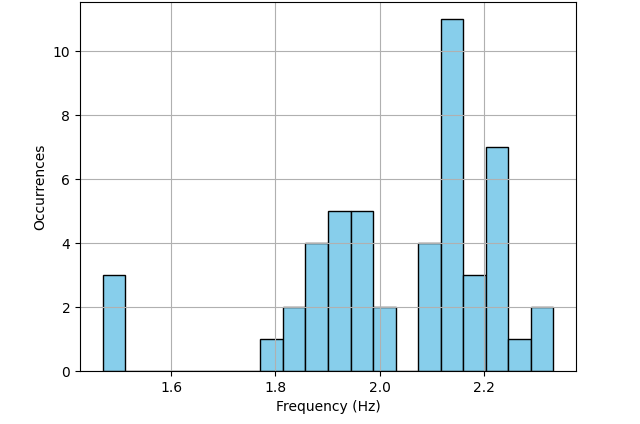
Histogram of first natural frequencis (stochastic foundation)
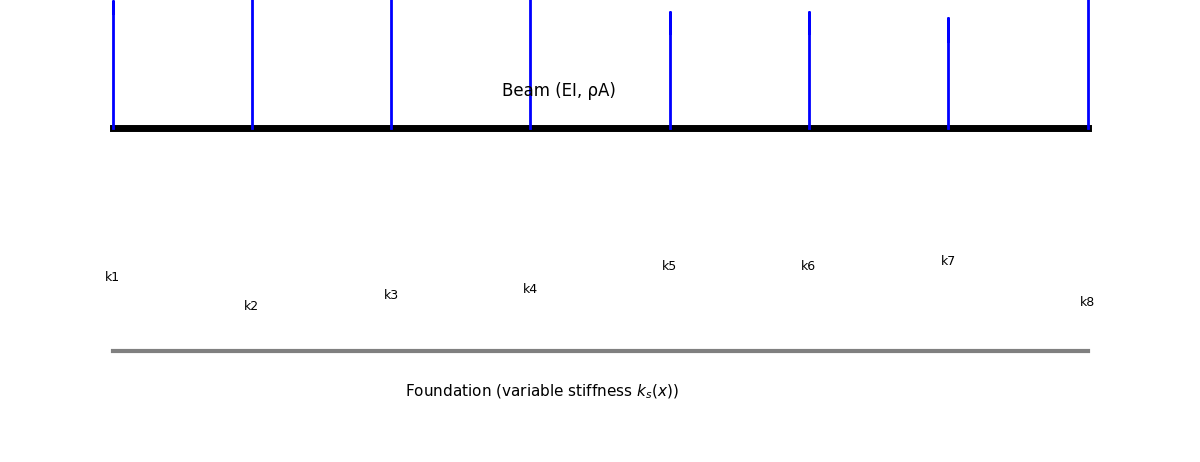
Schematic diagram of the beam on a stochastic foundation
4. Discussion
The obtained results highlight important engineering implications. Structures founded on heterogeneous or insufficiently characterized soils are susceptible to resonance and unexpected dynamic amplification, particularly under cyclic or seismic loading conditions. Conventional deterministic design approaches may underestimate such risks, potentially compromising structural safety and serviceability. The results emphasize the importance of incorporating probabilistic design measures, such as reliability indices or safety margins derived from frequency distribution quantiles. Furthermore, the findings reinforce the necessity of site-specific geotechnical investigations, as reliable statistical characterization of soil properties significantly improves model accuracy and risk assessment. From a scientific perspective, the demonstrated relationship between correlation length and mode localization provides new insight into stochastic soil–structure interaction. The study shows that not only the magnitude of variability but also its spatial structure governs dynamic uncertainty.
5. Conclusion
From a scientific perspective, this work advances stochastic foundation dynamics by demonstrating how spatial variability — not merely variability magnitude — governs dynamic uncertainty. The observed relationship between correlation length and mode localization represents an original contribution to the understanding of stochastic soil–structure interaction. This study provides a comprehensive stochastic investigation of the dynamic characteristics of foundation beams resting on spatially varying elastic supports. By modeling the subgrade modulus as a Gaussian random field and using the Karhunen–Loève expansion to discretize its variability, we integrated realistic soil behavior into the finite element dynamic analysis framework. The results clearly demonstrate that soil heterogeneity has a significant impact on the dynamic response of structural elements. Specifically, the natural frequencies and mode shapes of the beam are strongly influenced by the statistical properties of the foundation, including the mean stiffness, standard deviation, and spatial correlation length.
Key contributions of this work include:
– The use of Monte Carlo simulation to capture the probabilistic distribution of dynamic responses.
– Quantitative evidence showing the non-negligible uncertainty in natural frequencies due to stochastic subgrade effects.
– Practical insights for engineers and designers into the risks of ignoring stochastic variability, such as increased susceptibility to resonance or fatigue.
By combining stochastic modeling techniques with numerical simulations, this study contributes to the growing field of uncertainty-aware structural dynamics. It supports the integration of probabilistic safety concepts into civil and geotechnical design practices, particularly for infrastructures such as pipelines, railways, and buried beams where foundation behavior is crucial.